

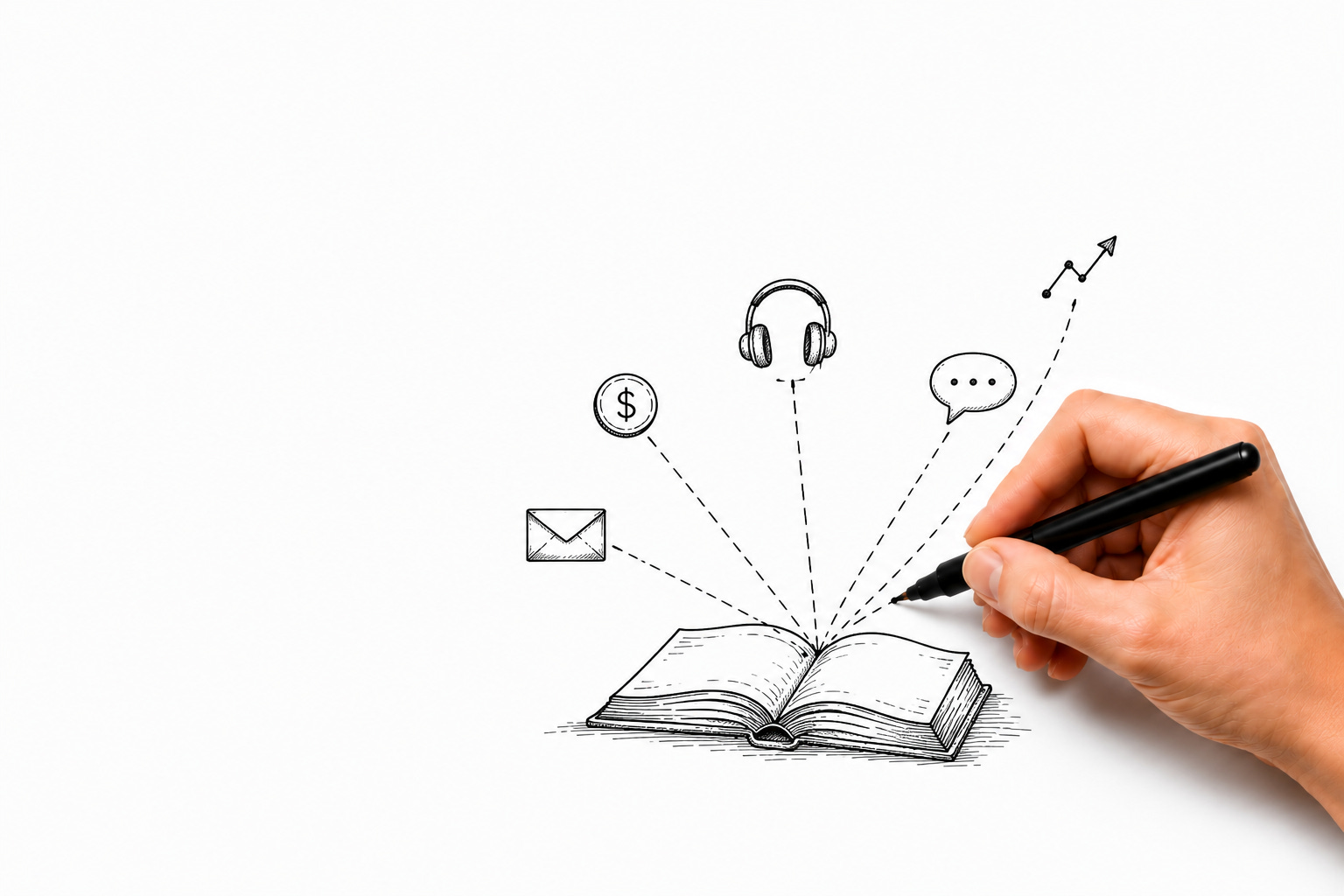
Quick answer: A single manuscript can generate income through five channels: book formats (ebook, paperback, hardcover, audiobook, Kindle Unlimited page reads), wide distribution (IngramSpark, Draft2Digital, PublishDrive, Findaway Voices), content multiplication (translations, bundles), an email list (lead magnets, affiliate offers), and authority-building (courses, coaching, speaking, certification). Most authors only ever use the first one.
If you publish once, on one platform, in one format, chances are — it won’t go very far. But, most Christian Indie authors don’t want to build a business, they just want to write their book. Those are two very different things, and it’s the reason why a lot of authors get stuck in that gap.
What they don’t realize is, it’s just the first stop on a much bigger map.
So, where do you begin? By making one book, whether you’re an existing author or upcoming one, do more work.
To achieve this, you repackage one finished book across six areas: the formats you sell it in, stores you get it into, new books hiding inside it, the email list it can build, authority it earns you, and eventually — if you keep at it long enough— the income it turns into.
Here’s the whole map, walked one piece at a time.
When you upgrade, that's when we start working for you, not just about you. Your book gets pushed in front of readers actively looking for it. We flag you for launch campaigns. When something in the algorithm shifts or a promo opportunity opens up, you're top priority.
The upgrade isn't the end of the process. It's when we start.
$100/year ($8.33/month)
Every format the same file can become
Start with the book itself, in every version a reader might actually reach for.
Kindle ebook first. Lowest barrier to entry, 70% royalties through KDP if you price between $2.99 and $9.99. It won’t make you a lot of money by itself, but every other format on this list starts from this same file.
Paperback outsells the ebook for most nonfiction and devotional titles, and it’s not close. Readers still want something they can underline, dog-ear, and hand to a friend at church. Turning your ebook into a paperback is formatting, mostly: adjust for print trim size, add a spine and back cover, upload. Budget around $40 total for someone to handle that.
Hardcover isn’t for every niche, but gift books and anything meant to sit on a shelf for years benefit from the option. You reuse the paperback manuscript. The only new cost is adjusting the cover margins for the thicker binding, usually another $10.
Then audiobook, and this is one Christian authors sleep on the most, which is strange because Christian audiences listen to things constantly. Long drives to church. Dishes. Laundry. Through ACX, narration runs about $70 per finished hour, and a 30,000-word book usually comes out to three finished hours, so figure $210 to $310 total. A modest audiobook brings in $50 to $100 a month once it’s live. ACX is currently open to authors publishing from the US, UK, Canada, or Ireland.
Last one in this group is Kindle Unlimited page reads. If your ebook sits in KDP Select, you get paid every time a subscriber reads a page, not just when someone buys the book outright. It’s a separate royalty line from your regular ebook sales, and it grows fastest on a book that actually holds someone’s attention start to finish.
Five income lines. One manuscript. Not a single new word written.
Formats at a glance:
Kindle ebook — 70% royalties, $2.99–$9.99 price range
Paperback — around $40 one-time formatting cost, usually the top earner
Hardcover — around $10 on top of your paperback files
Audiobook via ACX — $210–$310 to produce, $50–$100/month once live
Kindle Unlimited page reads — passive royalty layer on top of ebook sales
Getting the same book into stores Amazon can’t reach
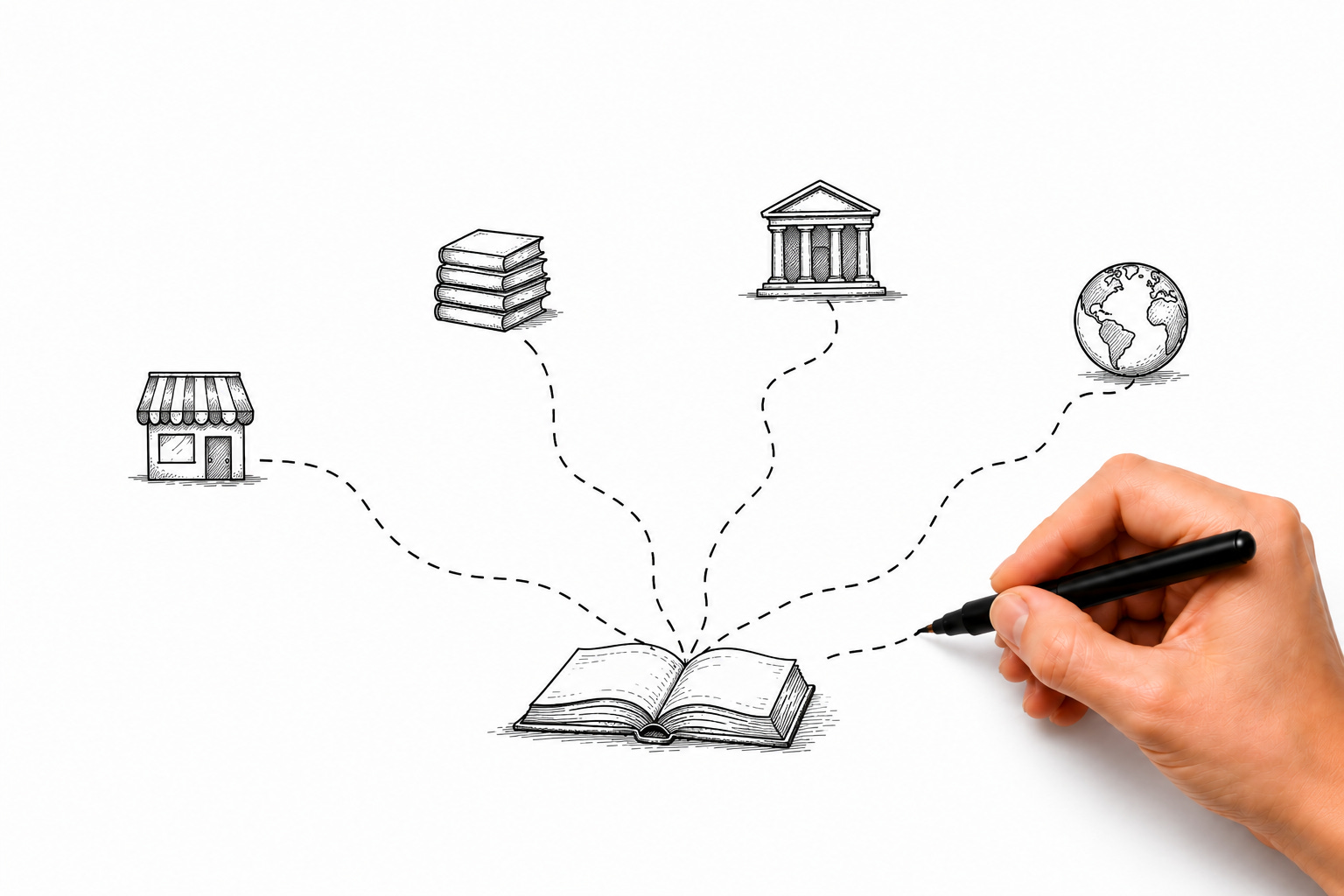
Amazon still dominates. It isn’t the whole market, though, and this next stretch is about getting the same formats in front of readers who never open the Amazon app.
IngramSpark sends your paperback and hardcover to over 40,000 stores, including church bookstores, Christian college bookstores, homeschool co-ops, and libraries. There’s no exclusivity requirement, so you can publish through IngramSpark the same day your files are ready on Amazon. Draft2Digital sends your ebook to Apple Books, Barnes & Noble, and Kobo, though only once your ebook is out of KDP Select (Select requires exclusivity to Amazon in exchange for the page-read royalties and promotional tools). PublishDrive covers a lot of the same ground as Draft2Digital, plus a handful of stores Draft2Digital doesn’t touch, so it’s worth uploading to both rather than picking one. On the audio side, Findaway Voices and Author’s Republic both function as the audiobook equivalent of IngramSpark, sending your finished narration to iTunes, Google Play, Kobo, and various libraries, with a slightly different store mix between the two.
Timing matters more than people think. Run the ebook through KDP Select first. It gives your book a visibility boost on Amazon and unlocks free promotions and Kindle Countdown Deals while you push through your launch. Once sales taper off, and a common marker for that is somewhere under $15 a month, pull it out of Select and move it to Draft2Digital and PublishDrive. Paperback and hardcover don’t need to wait on any of that. IngramSpark has no exclusivity clause, so it can go live alongside your Amazon listing from day one.
Distribution channels at a glance:
IngramSpark — paperback and hardcover, 40,000+ stores and libraries, no exclusivity required
Draft2Digital — ebook, Apple Books/Barnes & Noble/Kobo, requires leaving KDP Select first
PublishDrive — ebook, overlaps Draft2Digital with a few extra stores
Findaway Voices — audiobook, iTunes/Google Play/Kobo/libraries
Author’s Republic — audiobook, similar reach to Findaway Voices with a different mix
Turning one book into two, three, or four books
This is where a single manuscript becomes several books, each one able to run back through every format and every store above.
Translations first, and Spanish specifically. Spanish-language Christian markets are wide open next to English, where the keyword competition is brutal. Search Amazon for the Spanish version of whatever topic you write on and you’ll usually find a fraction of the listings you’d find in English, sometimes under 25 titles competing for a keyword that has thousands of English competitors. A translated book can land on page one without much marketing at all. Spanish first, then German, Italian, French, Portuguese if the first one does well. Hire a human translator, or use AI translation with a human editor reading every page (accuracy matters even more in devotional and theological content, so don’t skip that pass). Translation services usually run $1.29 to $1.39 per 100 words, editing included. A translated book counts as a brand-new listing to Amazon, which means it gets its own shot at everything in the two sections above.
Bundles work almost the same way. Once you have two or more books, package them into a box set. Readers see a bundle as a better deal than buying each title separately, and it costs you next to nothing, since every interior file already exists. The only new expense is a bundle cover. A bundle counts as a new listing too, so it can run through the format and distribution stages on its own.
A couple of things worth knowing before you build one: nonfiction bundles aren’t allowed on Draft2Digital, though they are on PublishDrive, and Audible allows only one bundle combination per set of titles. If you have three books, you can bundle A+B, B+C, A+C, and A+B+C as separate listings on KDP, but Amazon’s terms frown on duplicate-content abuse, so keep it to a reasonable handful.
Content multiplication at a glance:
Spanish translation first — lowest competition, ~$1.29–$1.39 per 100 words
German, Italian, French, Portuguese next, once Spanish proves out
Bundles — near-zero cost beyond a new cover, counts as a new listing
Bundle limits — one combination per title set on Audible, restrictions on Draft2Digital for nonfiction
What happens after someone finishes the book
None of this comes from reformatting anything. It comes from what happens after a reader closes the book.
Put a short call to action inside the book itself, a page offering a free checklist or a bonus chapter in exchange for an email address. The reader opts in, and now you have a way to reach them again instead of losing them the second they set the book down. The opt-in page that collects the email should stay dead simple, one offer, one form, nothing pulling attention away from the sign-up. Any email platform can build this in an afternoon.
Once someone’s on the list, you can recommend relevant products and earn a commission when they buy. A Christian parenting book might promote a family devotional. A financial stewardship book might promote budgeting software. Search “[your topic] affiliate programs” and you’ll usually find more than you expect. Realistically this stream sits around a few hundred dollars a month, but it’s close to fully passive once the emails are written.
If you already run a ministry, a consulting practice, or a service business, the book becomes a lead generator that funnels readers straight into what you already sell. If you don’t have anything like that yet, the list becomes the on-ramp into building a course instead, which is the next section.
Build the list even if you never touch anything else on this map. It’s the one asset that doesn’t live or die with any single platform. If your Amazon account has a problem someday, you still have your readers. If a bookstore drops your title, you still have your readers.
Email list mechanics at a glance:
Lead magnet inside the book — free checklist, bonus chapter, or companion PDF
Opt-in page — one offer, one form, no distractions
Affiliate offers to the list — realistically a few hundred dollars a month
Backend products — routes readers into your existing ministry, service, or course
Turning the book into influence
This is where the book stops selling copies and starts opening doors, and this section has the highest ceiling of the whole map.
If your book teaches a process (how to pray through grief, how to disciple your kids, how to plant a church), that process can become a paid course. You’ve already written the content once. The course just gives readers more structure and more direct access than the book alone offers. Consulting and coaching work the same way from a different angle. A well-written nonfiction book proves you know what you’re talking about before you ever open your mouth, and some readers finish it thinking, I don’t want to do this myself, I want to hire whoever wrote this. That’s the book doing exactly what it was supposed to do.
Speaking gigs can come straight out of a strong chapter. Some authors land repeat invitations off a single chapter that happened to hit the exact topic an organization was already looking for. And once you’re booking speaking engagements regularly, you can negotiate books into the contract itself, so instead of a flat fee, the host also buys a copy for every attendee. You get paid to speak, get paid on the books, and the book ends up in far more hands than an online sale would ever manage.
The one most authors never consider is certification. If your book teaches something other people could coach, train, or speak on, you build the materials once (a guidebook, a slide deck, a short course) and certify other people to deliver your content under your name. You’re not managing them as employees. Most certification models charge a one-time fee, often under $1,000, for the training itself, and the certified coach keeps whatever they earn coaching, speaking, or reselling the course to their own audience. This fits ministry-adjacent nonfiction especially well, recovery, discipleship, marriage, trauma healing, where the need for trained facilitators outstrips what any single author could reach alone. Start by building the coaching materials for yourself. Ask what would help you coach your own readers better, turn that into a guidebook and a slide deck, and only then think about whether other people should carry it too.
Authority streams at a glance:
Online course — repackages what the book already teaches into a paid, guided format
Consulting/coaching — readers hire you instead of doing it themselves
Speaking — one strong chapter can become a recurring talk
Books as a speaking-fee add-on — negotiate copies into the contract
Certification — train others to coach or speak on your material, one-time fee model
The exit, eventually
Once a book, or a small catalog of books, is generating steady, documented income across all of this, the account itself becomes something you can sell. Digital publishing businesses tend to carry a healthier margin than most physical-product businesses, since there’s no inventory and barely any overhead once the books are live. This isn’t something to plan around on day one. It’s just worth knowing it’s there, at the far end of the map, proof that none of this was ever really about selling books one copy at a time.
What it looks like stacked together
Take one 150-page nonfiction book and run it through all of this. That single manuscript ends up as an English ebook, paperback, hardcover, and audiobook, with Kindle Unlimited page reads on top. It’s wide-distributed through IngramSpark, Draft2Digital, PublishDrive, Findaway Voices, and Author’s Republic. It exists as a Spanish translation with its own ebook, paperback, hardcover, and audiobook, running through that same distribution list a second time. It’s part of a bundle with the next book you write. It feeds a lead magnet, which feeds an email list, which sells affiliate products and whatever you build next. And somewhere in there it becomes the foundation of a course, a coaching practice, a speaking career, or a certification program training other people to carry the message further than you ever could alone.
Where to actually start
You don’t need every stream on this list, and trying to build all of it at once would sink you, mostly because you’d spend money on certification materials before you’d even confirmed the paperback sells. Work through it roughly in order. Prove the book in formats first, for a few months. Let what it earns fund the distribution stage. Start the email list early and let it grow quietly in the background the whole time, since it costs almost nothing and everything else on this list eventually depends on it.
Frequently asked questions
How many income streams can one book actually produce? Realistically, five to ten active ones without stretching: ebook, paperback, hardcover, audiobook, Kindle Unlimited page reads, wide distribution through IngramSpark and the ebook/audiobook aggregators, at least one translation, and an email list feeding affiliate offers. Translations and bundles can each add another full set on top of that, since Amazon treats them as new books.
What’s the fastest income stream to set up from an existing book? Paperback. If the ebook already exists, converting it to paperback is mostly formatting and usually costs around $40 total, with no new writing required.
Do I need KDP Select to make money from Kindle Unlimited? Yes. Kindle Unlimited page reads only pay out on books enrolled in KDP Select, which requires the ebook to stay exclusive to Amazon. Most authors run Select during the launch window, then move to wide distribution once sales taper off.
Is translating a Christian book into Spanish actually profitable? It can be, and it tends to be one of the least competitive options available. Spanish-language Christian keyword searches on Amazon often return far fewer listings than the same keyword in English, which makes it easier for a new translation to rank without much marketing.
What’s the difference between Draft2Digital and PublishDrive? Both distribute ebooks to retailers outside Amazon, and their store lists overlap heavily. PublishDrive reaches a handful of stores Draft2Digital doesn’t, so most authors upload to both rather than choosing one over the other.
How much does it cost to turn a book into an audiobook? Through ACX, narration runs about $70 per finished hour. A 30,000-word nonfiction book typically produces around three finished hours of audio, putting the total cost in the $210 to $310 range.
Can I sell my publishing business once it’s making money? Yes, once it has a documented income history. Digital publishing accounts tend to carry stronger profit margins than physical-product businesses, since there’s minimal inventory or overhead once the books are live.
This is SO helpful! Now for my to-do list 🤣
Writing the book and building a business around the book are two completely different skills. A lot of talented authors never make that second jump.